Make Every Lap Count: Leveraging Deep Lap Analysis to Boost Stroke Efficiency
Make Every Lap Count: Leveraging Deep Lap Analysis to Boost Stroke Efficiency
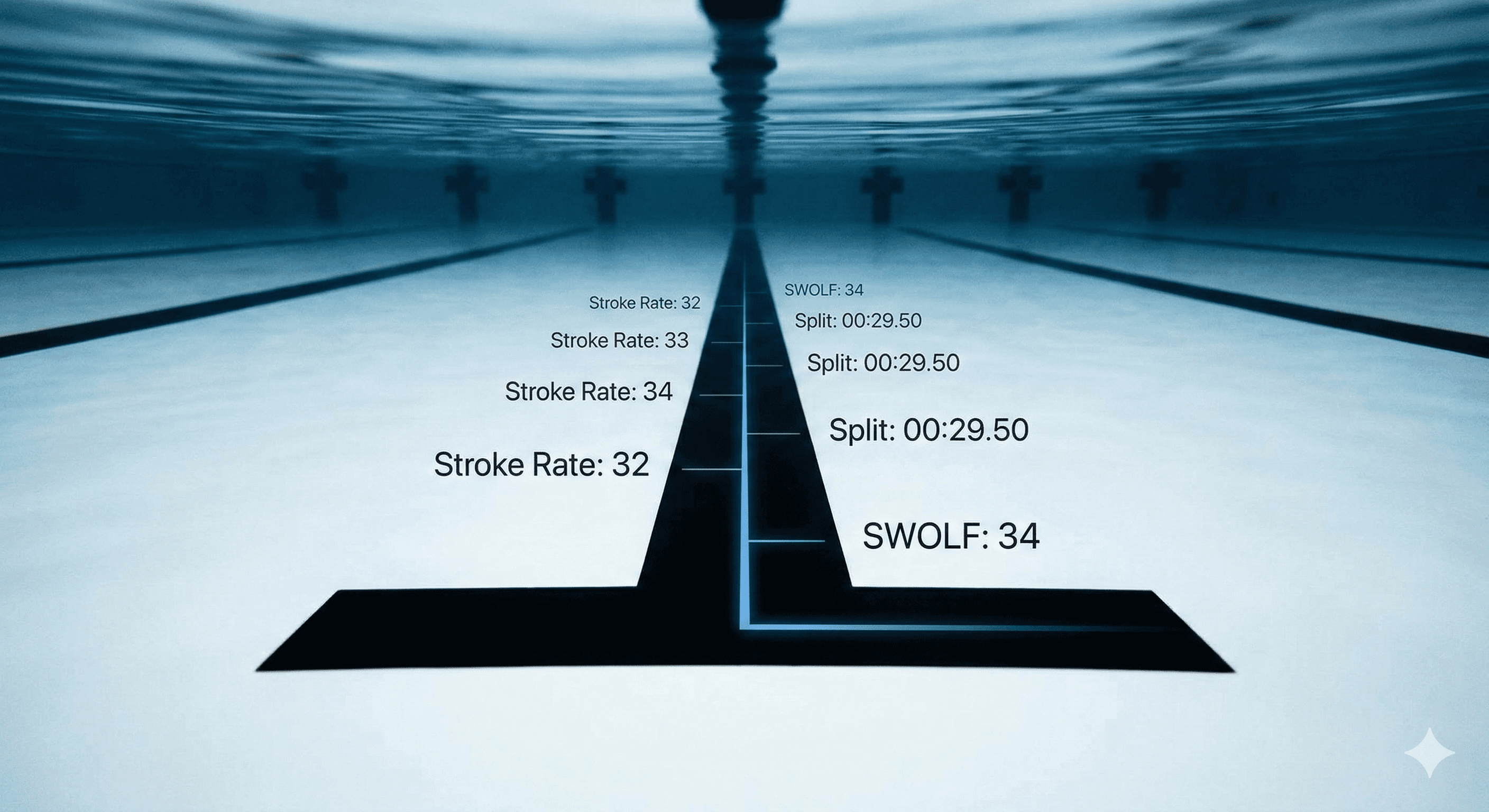
In the world of competitive swimming, there is a silent guide at the bottom of every pool: The T-Line. That simple, bold blue or black line isn’t just a marker for your turn; it represents the path of maximum efficiency.
To "make every lap count" means more than just hitting your yardage. It means ensuring that every stroke, every push-off, and every breath is optimized. In 2026, the secret to achieving this doesn't lie in complex AI predictions, but in the purity and refinement of your raw swim data.
1. The Anatomy of a Perfect Lap
To improve your stroke efficiency, you must first deconstruct the lap. Most generic trackers simply tell you that you swam 50 meters. A professional-grade analysis tells you how you swam it.
By leveraging iOS native data refinement, we can now look past the surface "noise." This technology filters the high-frequency motion of your Apple Watch sensors to provide a crystal-clear picture of:
The Breakout Phase: Are you losing velocity before your first stroke?
Stroke Consistency: Is your 15th stroke as powerful as your 1st?
Turn Efficiency: How many milliseconds are you "dead" in the water during a flip turn?
2. Refining the Raw: Why Native Data Matters
Many third-party apps layer heavy algorithms over your swim, often "hallucinating" or smoothing out data that should be analyzed for flaws. Our approach is different.
By focusing on refined iOS data, we maintain the integrity of your biomechanics. When the data is refined rather than replaced, you see the truth of your swimming:
Accurate SWOLF Scores: A refined stroke count combined with precise timing gives you an honest efficiency metric.
Interval Precision: Knowing exactly when you left the wall allows for tighter training cycles.
3. The T-Line Philosophy: Focus Through Minimalism
The "T-Line" brand imagery isn't just an aesthetic choice; it’s a performance philosophy. Just as the physical T-line helps you stay centered in your lane, a clean, professional UI helps you stay centered in your training.
"Eliminate the clutter, amplify the signal." When you finish a grueling 4,000-meter set, you don't need a barrage of social features or predictive AI "tips." You need a clear, high-contrast visualization of your lap analysis—a digital T-line that points directly to where you can shave off half a second.
4. Turning Analysis Into Action
How do you use this deep analysis to boost efficiency tomorrow?
Identify the "Fade": Look at your last 5 laps of a 200m set. If your stroke count increases while your speed decreases, your efficiency is collapsing.
Optimize the Push-off: Use the refined turn-detection data to see if your glide is slowing down too early.
Sync with HealthKit: By keeping the data native and refined, your swim performance integrates perfectly with your overall physiological recovery in the iOS ecosystem.
Conclusion: The Path of Least Resistance
Efficiency is the art of moving through water with the least resistance possible. Your tracking app should follow the same principle. By choosing a tool that focuses on iOS native data refinement and the T-Line imagery, you are choosing a partner that values precision over noise.
Stop just counting laps. Start analyzing them.